
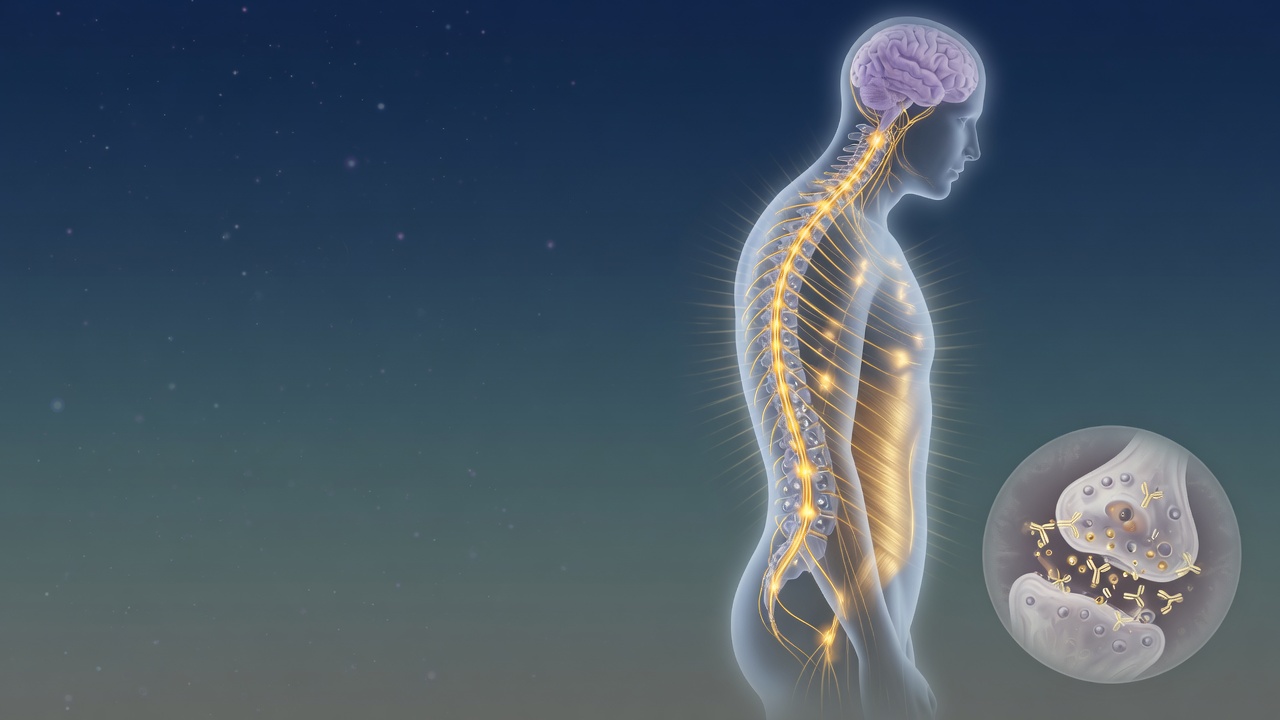
CAR-T Trial Delivers “Unprecedented” Results
The KYSA-8 trial just reported outcomes that doctors called “truly remarkable” — results they’ve never seen with existing therapies. This could become the first FDA-approved therapy specifically for SPS (expected 2026).
For a condition with no approved treatments, this is transformative. Regulatory review planned for first half of 2026.
Quick Facts About SPSD
Abstract
Stiff Person Syndrome (SPS), now commonly described within the stiff-person spectrum disorder (SPSD), is a rare immune-mediated neurological condition in which inhibitory signaling in the nervous system becomes impaired. Many people have antibodies such as anti-GAD65, which act as biomarkers of this autoimmune process, while other variants involve antibodies that may directly affect synaptic targets such as glycine receptors.
When inhibitory signaling is disrupted, muscles remain continuously active and can spasm suddenly. People may feel trapped in a rigid body, develop startle sensitivity, and experience significant pain and fatigue.
Diagnosis frequently takes years. There is no cure, but treatments can reduce stiffness, spasms, and functional disability for many patients. Emerging therapies — including B-cell–targeted approaches and cellular therapies — may change long-term disease control.
Early recognition and coordinated care improve mobility, sleep, safety, and quality of life.
Introduction
SPSD is a real neurological disorder involving abnormal motor inhibition — not a psychological condition. The immune system interferes with neural circuits that normally calm muscle activity.
Symptoms often begin gradually: stiffness, exaggerated startle, painful spasms, and increasing fear of movement due to unpredictable episodes. Understanding SPS requires viewing it as a spectrum disorder with multiple subtypes rather than a single uniform disease.
“We know the suffering, the severe rigidity, the falls, the fractures, the spasms.”
“Seventeen years just shows how long it takes for some people to get diagnosed, even the person who has the most resources available to her.”
How Does SPSD Affect the Body?
What’s Happening in the Nervous System
Normal movement requires balance between excitation and inhibition. In SPSD:
- Inhibitory signaling (GABA and sometimes glycine) becomes impaired
- Anti-GAD65 is the most common biomarker
- Some antibodies (e.g., glycine receptor) may directly disrupt synaptic function
- Loss of reciprocal inhibition causes opposing muscles to contract simultaneously
- This produces continuous stiffness and sudden spasms
Anti-GAD65 antibodies are widely considered markers of autoimmune dysfunction, and their exact pathogenic role remains an active research question.
Historical Timeline
How Rare Is SPSD?
Understanding how common (or rare) SPSD truly is has evolved significantly:
- Older estimates: ~1 per million
- Recent population-based data (Colorado health-system study): ~1.36–2.11 per 100,000, with incidence ~0.35 per 100,000 person-years
These newer estimates likely reflect improved recognition, antibody testing, and broader spectrum definitions, rather than a proven increase in true disease frequency. Better awareness means better diagnosis — but the condition itself hasn’t become more common.
Clinical Variants (Spectrum Framework)
SPSD is not one uniform disease but a spectrum with distinct presentations:
Diagnosis
Diagnosis is clinical and supportive rather than based on a single test.
Key Elements
- Characteristic stiffness/spasm pattern
- EMG showing continuous motor unit activity
- High-titer antibodies (especially GAD65) supporting diagnosis
- Exclusion of mimics
Low-titer anti-GAD65 can occur in diabetes and does not diagnose SPS by itself. Misdiagnosis remains common.
Differential Diagnosis
Common conditions that can be mistaken for SPSD:
- Functional neurological disorder
- Parkinsonism
- Multiple sclerosis
- Dystonia
- Hereditary spastic disorders
- Fibromyalgia (pain overlap)
Response to GABA-enhancing medication can support diagnosis but is not definitive.
What Antibody Results Mean — and Don’t Mean
This is the single most important thing to understand about SPSD diagnosis:
Anti-GAD65 antibodies are NOT a yes/no diagnosis.
- High titers (especially in serum AND CSF) support SPSD diagnosis when combined with clinical features
- Low titers are common in type 1 diabetes and other conditions — they do NOT mean you have SPSD
- Negative antibodies don’t rule out SPSD — some variants involve other antibodies (glycine receptor, amphiphysin) or are seronegative
- Positive antibodies alone without clinical symptoms do NOT diagnose SPSD
Bottom line: Diagnosis requires the complete clinical picture, not just a lab value. This prevents confusion, misdiagnosis, and anxiety.
Genetics & Comorbidities
SPSD is not caused by a single gene, but immune-related genetic susceptibility exists.
Genetic Associations
- HLA-DQB1 variants
- Reported KLK10 association (needs replication)
Common Comorbidities
- Type 1 diabetes
- Autoimmune thyroid disease
- Other autoimmune disorders
- Anxiety and trauma-related symptoms (often secondary to unpredictability)
The Patient Journey
The typical path from first symptoms to effective management:
Delays of several years are typical. This is why awareness and early recognition matter so much.
Living With SPSD
People often describe:
- Fear of sudden spasms
- Loss of independence
- Social isolation
- Hypervigilance
Individual outcomes vary widely. Patient stories illustrate possibilities, not guarantees. Each person’s journey with SPSD is unique.
Pediatric SPSD
While rare (~5% of cases), pediatric SPSD has important differences:
- Often presents differently (gait issues, spasms first)
- Diagnosis delay can be longer
- Early treatment helps prevent secondary complications
Treatment Approaches
Treatment is hierarchical and individualized based on symptom severity and subtype.
Symptomatic Therapy
First-line approaches to manage stiffness and spasms:
- Benzodiazepines (diazepam, clonazepam)
- Baclofen (oral or intrathecal)
- Physical therapy
- Trigger management (noise, stress, temperature)
Immune Therapy
Strongest evidence in classic SPS:
- IVIg — Best randomized evidence (2001 trial)
- Rituximab — Variable evidence
- Steroids — Depending on presentation
- Plasma exchange — For severe cases
- Immunosuppressants — Subtype-dependent
Breakthrough Therapies
Next-generation approaches under investigation:
- CAR-T therapy (miv-cel) — Phase 2 results showed unprecedented improvement; BLA submission planned 1H 2026
- FcRn inhibitors
- Neuromodulation approaches
CAR-T remains experimental for SPSD. The December 2025 results are promising but approval is not yet final.
Safety & Practical Care
Key Risks to Manage
- Falls and fractures
- Medication sedation
- Startle triggers (sound, touch, stress)
- Reduced mobility
- Bone health concerns
Rehabilitation Focuses On
- Range of motion
- Fear reduction
- Safe movement strategies
- Trigger identification and management
Prognosis
Course varies significantly between individuals:
- Some stabilize with treatment
- Some experience fluctuating symptoms
- A subset progress over time
Early immune therapy is associated with better functional outcomes. This underscores the importance of timely diagnosis and treatment initiation.
Research Directions
Major themes in current SPSD research:
- B-cell–targeted therapies
- Cellular immune reset strategies (CAR-T, stem cell)
- Biomarker refinement
- Earlier diagnosis strategies
- Spectrum classification and phenotyping
Community & Support Resources
Yes — and they matter enormously. SPS is isolating, and peer support changes outcomes.
Stiff Person Syndrome Research Foundation (SPSRF)
The main global hub for SPS resources, research, and community.
- Support groups
- Patient registry
- Educational webinars
- Strong clinician connections
RareConnect (EURORDIS)
International moderated rare disease community with SPS-specific discussion groups.
NORD IAMRARE Registry
Research-focused registry that also connects community members.
Facebook Support Groups
Large, active communities where practical knowledge lives:
- “Stiff Person Syndrome Support Group” (largest)
- “Stiff Person Syndrome Awareness”
- Several smaller private patient-only groups
These groups are often where practical knowledge lives — medication experiences, triggers, disability navigation.
Peer groups provide lived experience — not medical guidance. Always discuss treatment decisions with your healthcare team.
Moving Forward
Stiff Person Syndrome is rare, complex, and often misunderstood — but it is real, it is treatable, and there is hope.
The December 2025 CAR-T breakthrough represents a potential turning point for a condition that has had no approved therapies. While we await regulatory review, the research community, clinical teams, and patient advocates continue to push for earlier diagnosis, better treatments, and improved quality of life.
If you or someone you know is navigating SPSD:
- You are not alone — community matters
- Diagnosis takes time, but persistence pays off
- Treatment options exist and are expanding
- Early intervention improves outcomes
- Your experience is valid
There is hope on the horizon.
Sources & Further Reading
This guide draws on peer-reviewed medical literature and trusted rare-disease databases. Because these conditions are rare, much of what is known comes from case reports and small series — the sources below are where to read further and verify with your own clinicians.
- Stiff-person syndrome and related disorders — diagnosis, mechanisms and therapies. Nature Reviews Neurology, 2024. Nat Rev Neurol
- Therapies in Stiff-Person Syndrome. Neurology: Neuroimmunology & Neuroinflammation. Neurol Neuroimmunol Neuroinflamm
- IVIG treatment response in anti-GAD65 antibody-associated stiff person syndrome — case report and literature review. Frontiers in Immunology, 2024. Front Immunol
- National Organization for Rare Disorders. Stiff Person Syndrome. rarediseases.org
Last reviewed:
Community Voices
Stories and insights from the SPS community will appear here as they are submitted and reviewed. Be the first to share yours.
No stories yet — yours could be the first.